
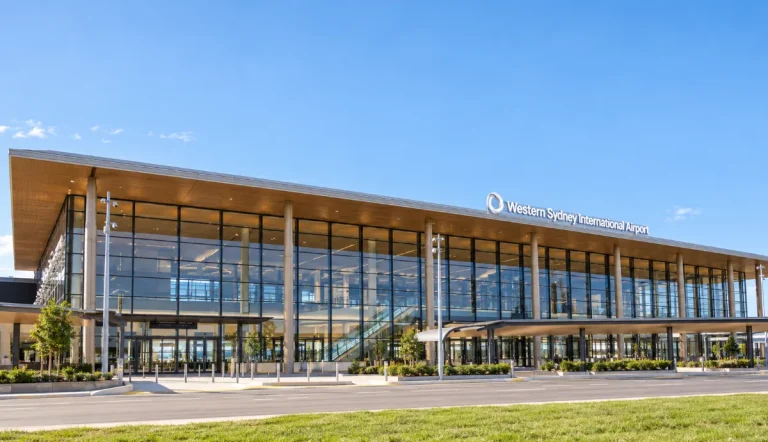
Western Sydney International Airport (WSI), Australia’s first major new airport in more than 50 years, began passenger operations on October 25, 2026, with a Jetstar flight to the Gold Coast. Air New Zealand operated the airport’s first international service to Auckland the following day.
The new airport, officially named Western Sydney International (Nancy-Bird Walton) Airport, is designed to handle up to 10 million passengers annually. The project involved 15 years of planning, seven years of construction and a further year of operational testing, according to Australia’s Department of Infrastructure.
Jetstar flight JQ362, operated by an Airbus A320, departed for the Gold Coast at 11 a.m. local time on October 25, carrying the first passengers from the new airport. Air New Zealand’s Auckland service followed on October 26. The airline operates three weekly return flights between Western Sydney and Auckland, on Mondays, Wednesdays and Fridays.
Airlines and terminal facilities
Domestic and international passengers use the same terminal, which has more than 40 check-in kiosks and 34 self-service bag-drop kiosks. The airport is designed to operate around the clock, without the nighttime curfew that restricts flights at Sydney’s existing Kingsford Smith Airport.
Airlines scheduled to serve WSI include Jetstar, Qantas, Air New Zealand, Singapore Airlines, Vietjet and Fiji Airways. Singapore Airlines plans to launch daily flights to Singapore on November 23, 2026. Vietjet is scheduled to begin services to Ho Chi Minh City in January 2027, while Fiji Airways plans three weekly flights to Nadi from March 19, 2027.
Digital air traffic control
WSI is Australia’s first airport built to operate without a conventional air traffic control tower. Instead, more than 20 high-resolution cameras monitor the airfield and nearby airspace, transmitting live images to controllers at a remote facility in Eastern Creek. The digital system also uses tools such as object tracking, image enhancement and infrared imaging to support operations in low visibility and at night. Air traffic controllers continue to manage aircraft movements and clearances.
The airport forms part of an approximately A$18 billion investment in Western Sydney infrastructure. Planned transport improvements include a Sydney Metro connection to the airport and upgrades to nearby roads.